
AI and SEO in 2026: What Still Matters for Search Rankings
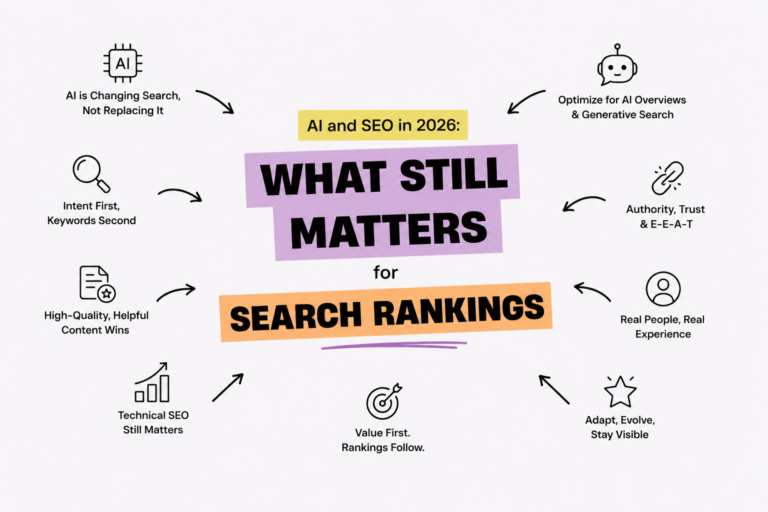
Every few months, a new wave of panic sweeps through marketing circles: AI is about to make SEO obsolete. Google’s AI Overviews are eating click-through rates. ChatGPT is becoming the new search bar. Content is dead, long live the algorithm.
Here’s the thing SEO has survived a dozen “this changes everything” moments before. Mobile-first indexing. The Panda and Penguin updates. Voice search. Featured snippets. Each time, the fundamentals didn’t disappear. They just got harder to fake.
AI is no different. It’s not replacing SEO it’s stripping away the shortcuts that never should have worked in the first place. The sites that were coasting on keyword density, backlink farms, or thin affiliate content are the ones losing visibility. The sites built on real expertise are, if anything, becoming more valuable.
What's actually changing
AI-generated summaries are absorbing a real share of informational searches, reshaping organic traffic patterns across the web. If someone wants to know “what is a landing page,” they may never click through to a website again they’ll get the answer directly in the AI Overview. That’s a genuine shift, and it’s already showing up in search rankings for purely definitional content. Some studies suggest informational queries have seen organic click-through drop by double digits since AI Overviews rolled out broadly.
This shift has a name now: Generative Engine Optimization (GEO) sometimes called Answer Engine Optimization. It’s the practice of structuring content so AI systems can understand, trust, and cite it directly, rather than just optimizing for a blue-link ranking. GEO isn’t a replacement for SEO; it’s an extension of it, built for a search landscape where the result is often a synthesized answer instead of a list of links.
Search engines are also getting sharper at detecting thin, templated, or AI-mass-produced content. The pages that hold their search rankings are the ones with a clear point of view, original data, or first hand experience the things a language model can’t fabricate convincingly. If your content reads like a summary of ten other articles, an AI system will happily produce that same summary itself, and skip citing you entirely.
What isn't changing
A few things remain exactly as important as they were five years ago:
Keywords are still less important than search intent
Understanding why someone is searching not just what they typed still separates content that ranks, and gets cited in AI answers, from content that doesn’t. A page stuffed with keywords but thin on actual answers fails both old-school SEO and GEO alike.
Technical SEO is still on the ground, not at the top
Site speed, crawlability, mobile performance, and clean site structure haven’t gone anywhere. Neither traditional search engines nor AI systems can rank or cite a page they can’t properly index. If your site has a slow load time or broken internal linking, no amount of great writing will save your search rankings.
Trust signals still compound
Backlinks from credible sources, consistent publishing history, and demonstrated expertise still tell search engines and now AI systems that your content is worth surfacing. This is often described as E-E-A-T (Experience, Expertise, Authoritativeness, Trustworthiness), and it’s become even more central to how AI models decide what to cite.
Original insight is still scarce
AI can summarize what already exists. It can’t run your experiment, interview your customer, or share your specific results. That gap is where the real opportunity now lives, and it’s exactly the kind of content GEO rewards. A single first-party data point or case study can outperform a thousand words of recycled advice.
What to actually do about it
Stop optimizing purely for algorithm mechanics and start optimizing for search intent the reader or AI system that needs a real source, not just a plausible-sounding one. That means fewer “ultimate guides” stitched together from the top ten results, and more content built on something you actually know that nobody else is saying.
Audit your content library for what’s genuinely original versus what’s just well-formatted consensus. The consensus content is the first to lose organic traffic to AI summaries it’s replaceable by definition. The original stuff is what AI systems increasingly cite as a source, which is becoming a new kind of visibility in itself, and the whole premise behind GEO.
It’s also worth restructuring key pages with AI citation in mind: clear headers that map to real questions, concise direct answers near the top, and supporting detail below. This format serves human skimmers and AI parsers equally well a rare case where good UX and good GEO overlap completely.
AI didn’t break SEO. It raised the price of admission. The fundamentals that always separated good content from filler intent, technical health, trust, and originality are exactly what will protect your search rankings for the next decade too, whether the reader on the other end is human or an AI system deciding what to cite.
Summary
AI Overviews and chatbots are changing how people search, but they haven’t made SEO obsolete they’ve made shortcuts stop working. This blog argues that a new discipline, GEO (Generative Engine Optimization), has emerged alongside traditional SEO to help AI systems find, trust, and cite your content. The core fundamentals search intent, technical health, trust signals, and original insight still decide who wins, whether the reader is human or an AI deciding what to cite. The practical takeaway: audit your content for what’s genuinely original versus recycled consensus, since the recycled stuff is what AI summaries replace first.